I have a lot to say about this book, and a lot to think about in terms of how I’d like to use Táíwò’s work in Indigenous Studies, and more broadly in my Indigenous Futurisms work – but for now I’ll be honing in on one particular section of the book. You’ll see why in a moment.
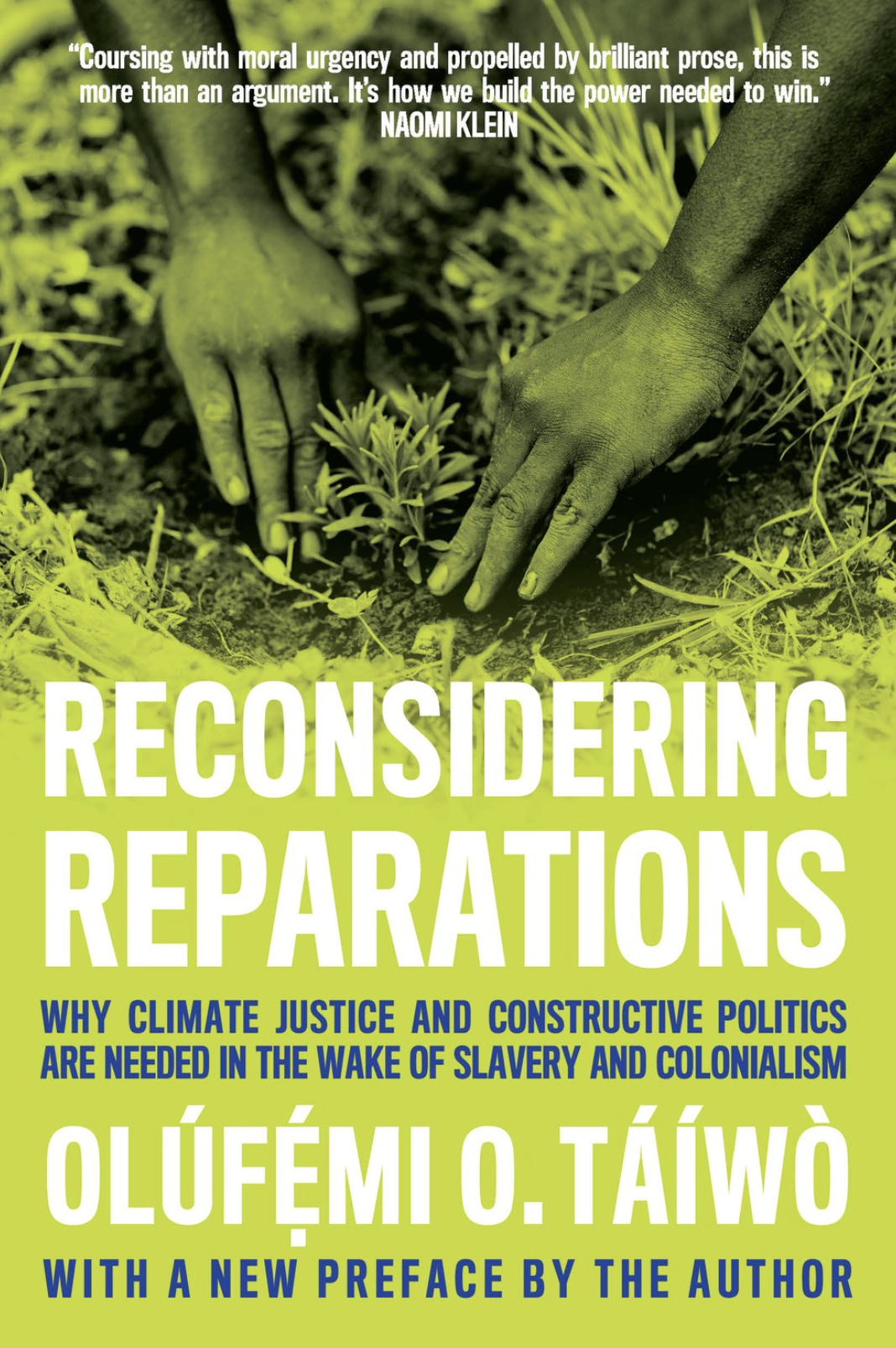
First, and briefly, Reconsidering Reparations: Why Climate Justice and Constructive Politics are Needed in the Wake of Slavery and Colonialism (2022) is part of a growing (and historically rooted) body of work that explicitly links the transatlantic slave trade and the colonization of the Americas (and beyond) to the wider global framework we all currently live within. [1] By exploring the ways in which Blackness and Indigeneity were co-constituted as colonial categories, and how these categories gave rise to structures and institutions that endure today, Táíwò theorizes a form of constructive reparations in the service of a global worldmaking.
Very simply put, the book argues this: the world we live in was built by slavery and colonialism, and no amount of reformation or historic restitution can change this – so we must remake the world. I am in firm agreement.
However, I was surprised when, halfway through the book, on pages 105 – 117, Táíwò offers what I would characterize as the kind of in-depth territorial acknowledgment I argue for in Beyond Territorial Acknowledgments – though he does not refer to it as such – and I really want to talk about it!
Territorial acknowledgements, also called land, title, or treaty acknowledgments, are statements intended to name and recognize the Indigenous origins of particular places; site based temporal summaries that link present-day Indigenous Peoples to their ancestor’s territories. They can become particularly criticized when they morph into what Sara Ahmed calls “institutional speech acts,” intended only to give the appearance of a commitment to equity or reconciliation. [2]
I’d argue Táíwò’s approach in this section expands beyond the potential purposes for territorial acknowledgments that I’ve previously identified, which are:
- From a settler perspective, recognition as a form of reconciliation;
- From an Indigenous perspective, a form of resisting erasure or honouring traditional Indigenous protocol;
- Making spaces feel less unsafe and unwelcoming for Indigenous Peoples. [3]
I named these general categories to group together the reasoning expressed by those writing and delivering territorial acknowledgments over the years – they are not necessarily what I think these statements should be doing. In fact, I’ve been arguing for years that they need to accomplish more. Luckily, Olúfẹ́mi O. Táíwò offers us an excellent example of what this could look like…even if he never thought of this as being a territorial acknowledgment in the first place!
In these pages, Táíwò provides an in-depth history lesson about how Georgetown University in Washington D.C. came to exist as an institution of higher learning, highlighting the ways in which Indigenous dispossession opened up the physical space for the university, as well as how enslaved labour and the direct sale of enslaved people created the financial infrastructure of the institution.
Now, it makes perfect sense why he nestled this particular history lesson in the middle of his book, after a very detailed exploration of what he refers to as a global racial empire. It illustrates his points brilliantly. This is not helpless fury, a hand waved toward the dirty old past, and a vague commitment to ‘doing better.’ Instead, Táíwò offers this piece within the wider context of thinking about actual steps to remake the world into a better place.
Nonetheless, in Indigenous circles, this would be the first chapter of the book because it locates the author in relationship to the territory he lives on, and how the space he works within came to exist. From an Indigenous perspective, locating oneself puts everything that comes after into relational context. It would make sense within Indigenous studies at least to start here.
Acknowledgment of the structural violences experienced by Indigenous Peoples that have made settler presence on these lands possible are not uncommon in territorial acknowledgments, though neither are they usually explored in any depth. But Táíwò does something much more extraordinary. He broadens the scope of what is generally a hyperlocal history to illustrate the way in which global forces shaped the events that created the institution he is a part of.
He does not skip over centuries of inter-European competition, or the disruptive reverberations of settler trade and diplomacy with competing Indigenous polities in what is now the United States, all of which which made Indigenous nations more vulnerable to naked violence and removal and seizure of vast areas of land. Then he takes us to Africa, where we gain a brief understanding of how similar tactics were used by Europeans on Indigenous populations there to accumulate enslaved people, some of whom were transported to grow tobacco on Jesuit plantations in the U.S. We learn about how this stolen land and labour enriched and made possible institutions like Georgetown, how enslaved people were sold off to settle its debts, and then how the Catholic church was involved in that country’s Indian residential school system.
Obviously, a territorial acknowledgment of such length and depth could not be recited before every Board of Governor’s meeting or university event, but the quantity of information is not what extends this narrative into something beyond a territorial acknowledgment. By refusing to flatten the interconnected and global structures and events that created this one institution, Táíwò has linked Black and Indigenous struggles to the wider global community that has been shaped by what he calls the Atlantic Order – the current world system built upon racial capitalism, the transatlantic slave trade, and Indigenous genocide.
He does not diminish or decentre Indigenous Peoples in this expansion. Instead, Táíwò refuses to silo moral and restorative culpability to his specific institution alone, or position Indigenous Peoples as a minority population to be reconciled with – a common but dangerous positionality, given that settler colonial states continue to seek to erase Indigeneity through socio-political as well as physical means. The ‘problem’ is not relationships between the state (and by extension these institutions) and Indigenous Peoples. The problem is that the foundations of our entire society are rotten and must be remade, and we need all hands on deck.
I would then like to propose another purpose that territorial acknowledgments can and should work towards:
- Calling for the remaking of the world, without requiring Indigenous Peoples to give up our Indigeneity or sovereignty, with the goal of creating a “global community thoroughly structured by non-domination.” (Táíwò, 102)
This would require a deep commitment to learning about and naming how advantages and disadvantages (as Táíwò discusses them) have become accumulated, and acknowledging that worldmaking requires deep relationality on a global level to accomplish a just redistribution.
When Indigenous Peoples discuss Land Back, we are talking about worldmaking, and we understand that we cannot do this in isolation. But as Táíwò points out early on in his book (drawing on the work of Toni Morrison, Rachel McKinney and others) when we are constantly forced into ‘extracted speech’ (and extracted acts) to humanize ourselves or make ourselves legible to systems of power, we have little energy left to do the kind of “imagining otherwise” required for worldmaking. [4]
I, for one, would like to stop allowing the settler colonial state to believe that territorial acknowledgments guarantee colonial futurity. Locating injustice only in the hyperlocal past means nothing needs to change because things are already better; territorial acknowledgments should be one way we challenge this notion. And if we as Indigenous Peoples do not understand and link our struggles to the struggles of other colonized and dominated Peoples around the globe, then our ‘liberation’ might very well take the form shaped for us by our own colonizers.
And truly, what the fuck kind of freedom would that be?
[1] Táíwò, Olúfẹ́mi O. 2022. Reconsidering Reparations: Why Climate Justice and Politics are Needed in the Wake of Slavery and Colonialism. Oxford University Press. [2] Ahmed, Sara. 2007. “‘You End up Doing the Document Rather than Doing the Doing,’: Diversity, Race Equality and the Politics of Documentation,” Ethnic and Racial Studies, 30(4), 590-609. https://doi.org/10.1080/01419870701356015. [3] Vowel, Chelsea. 2024. “Revisiting ‘Beyond Territorial Acknowledgments’.” âpihtawikosisân.com, November 21, 2024. https://apihtawikosisan.com/2024/11/revisiting-beyond-territorial-acknowledgments/ [4] With thanks especially to Cherokee scholar Daniel Heath Justice for his many articulations of “imagining otherwise”. Justice, Daniel Heath. 2018. Why Indigenous Literatures Matter. Wilfred Laurier Press.

1 Comment
Pam Thomson · January 6, 2026 at 9:56 pm
Bless you, Chelsea. This is a call to awaken our settler minds, to expand and include. Thank you.