tânisi nitôtêmitik! A while ago, I wrote about my dream to make nêhiyawêwin/Cree language learning more accessible. In short, we need a free-to-access online, asynchronous course for absolute beginners that blends instructional videos with exercises, answer keys, and listening exercises. The goal? Learners who get beyond memorizing word lists and isolated phrases to achieve high-beginner to low-intermediate fluency.
At that time, I’d successfully applied for a grant to work on the project for three months. My original goal was to create a twelve-module course in a similar format as what I’d developed at the University of Alberta, but once I began it quickly became clear that I wanted something better. Also, I’d vastly overestimated just how far the funding could take me, and underestimated just how much work it takes to build a course up from nothing.
(Before I get into my spiel about how the project has morphed into something I’m much happier with, feel free to go take a peek! Right now, mâci-nêhiyawêtân is the only course offered at courses.apihtawikosisan.com.)
When COVID hit and we all went online, I was developing my lessons as I went, bare-knuckling it with PDFs and a whiteboard. But this was after teaching the same courses for a few years already. At that point I could walk into a room blind-folded and deliver my lectures. It took me the next four years to really flesh out online components to my courses that I felt proud of – and I’d based my expectations for this Cree course on that.
Except I hadn’t designed the Cree course I was teaching at the university – I was expanding on it yes, but the format was provided to me. Once I got going on this project, I realized just how free I was to take it a different direction, FINALLY. And that changed everything.
In particular, I want to be able to introduce module vocabulary more contextually, and without translation. This means I had to learn how to storyboard, animate, and create soundtracks.
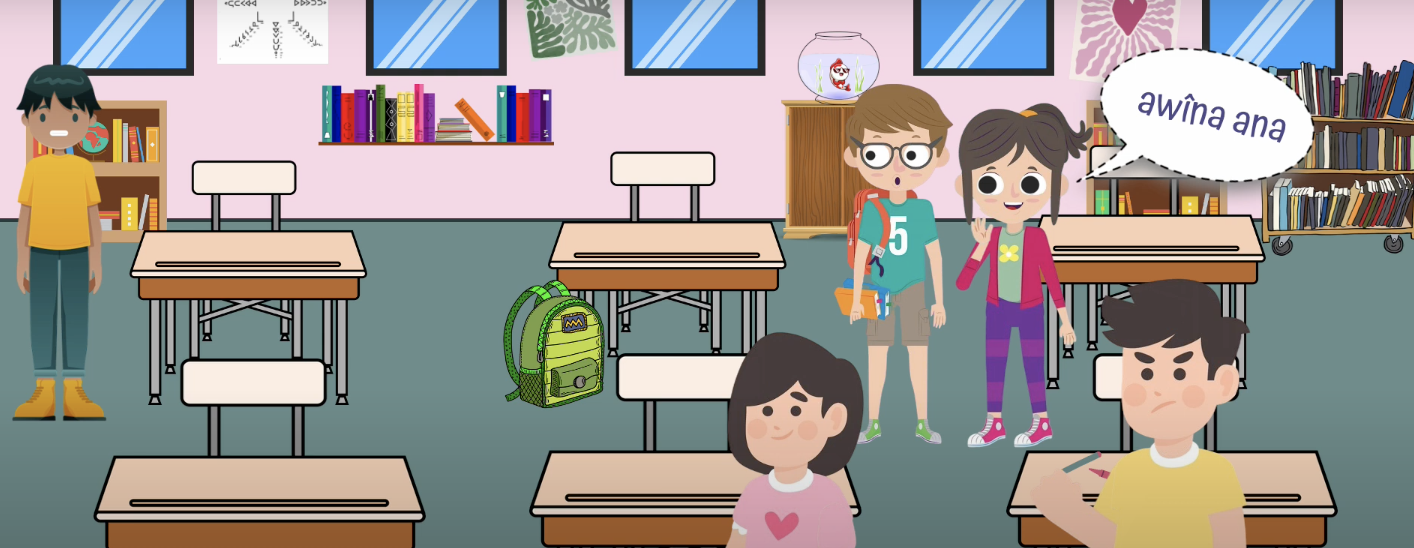
That all turned out to be a lot more work than recording off the cuff, the way I’m used to doing when teaching. Instead of sticking to the plan of creating twelve bare-bones modules that I’d fill in later, I chose instead to create a more complete proof of concept.
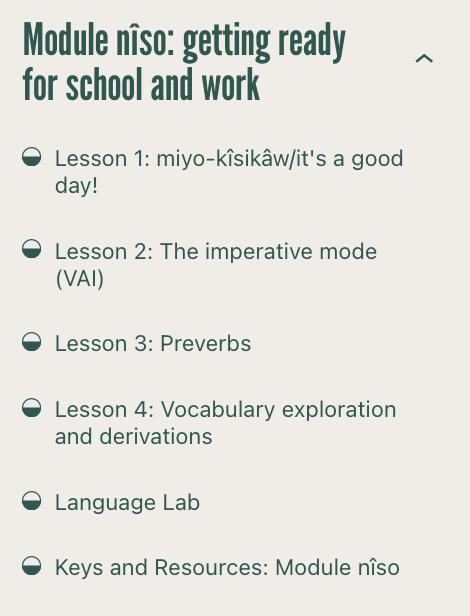
Modules and lessons are narrative-driven, centred around a specific activity or series of activities, like getting ready in the morning, or a first day at school. Vocabulary is introduced in a way that scaffolds and encourages learners to begin using nêhiyawêwin in their every day lives. I also happen to think that the story elements are hilarious, and I am super excited to be able to blend my talents as an author with my passion for language learning!
This then is a limited launch of the course, in the sense that instead of twelve modules, there are currently two-and-a-half. However, these modules are as close to what I envisioned as possible, and I don’t want to rush through this. I left the university to do this kind of development – I don’t have to try to get it done on my vacation (something you don’t get once you’re self-employed anyway). I can take the time to really flesh it out and support learners as much as possible. So that’s what I’m doing! I’m writing more grants, and taking a “break” to write a book. My hope is that I’ll be able to devote the bulk of next year on finishing the other modules. After that, I want to do another twelve-module course to keep learners advancing. Then a two-section intermediate course. Then…well you get the idea.
But enough talk – go ahead and take a look! Click the button above to head to the site, and let’s start speaking nêhiyawêwin/Cree!

11 Comments
Marie-Louise Perron · September 2, 2025 at 6:41 pm
Dear Chelsea Vowel,
I am soooooo happy you have developed this free-to-access, online, nêhiyawêwin learning course!
During COVID, I decided to bite the bullet and start getting back the Michif language I spoke as a child. Hadn’t even been able to envisage it before – my throat would close just thinking about it. From those first tentative Michif lessons, I was now looking for a course that would explain *how* Cree-Michif would work, and your course looks like it might do that for me.
Chi maarsii!
ianweniger · September 2, 2025 at 10:24 pm
The Communist Party of Canada used to have a nêhiyawêwin/Cree translation of “Workers of the world, unite!” at the top of the front page of every issue of their weekly paper… right up to the 1990s. The editors seemed to have decided it oughta be up there with French and English. Never saw an article in nêhiyawêwin/Cree, though. Hope we see some sooner now that Professor Vowel’s on the app!
Sylvia Smith · September 3, 2025 at 6:08 am
Congratulations on your dream coming true!
âpihtawikosisân · September 4, 2025 at 10:06 am
Thank youuuuuu!
pmoonwalker · September 3, 2025 at 10:15 am
I am totally excited about mâci-nêhiyawêtân and have always loved your teaching methodology. Gilakas’la
âpihtawikosisân · September 4, 2025 at 10:06 am
I hope you love this as it rolls out 🙂 Great to see you!
Tyler Pennock · September 5, 2025 at 7:32 am
🫶🏽
Beth McCubbin · September 12, 2025 at 8:36 am
Yeah! Well done!
From what I’ve read so far the course looks fabulous and the platform is excellent.
Thank you Chelsea Vowel 🙂
Jackie Nixon · September 12, 2025 at 9:36 am
Thank you thank you thank you!!!!!
bryceknudtson · April 22, 2026 at 2:29 pm
Thank you for making this resource! Just wanted to share some encouragement because we need to keep this alive.
Free, online, asynchronous course: mâci-nêhiyawêtân – Cree Literacy Network · September 11, 2025 at 8:09 pm
[…] latest project in support of language reclamation. Here’s how she described it on her blog, âpihtawikosisân, just last week: […]